

⚠ 2025 Alert: A new, more aggressive strain of Phytophthora ramorum (NA2) was discovered in Woodside and Burlingame in 2024 — and it thrives in warmer, drier conditions.
San Mateo County reported a 10.8% SOD infection rate in 2024 — up 3% from the prior year. Early treatment is more critical than ever.
Specialized SOD Treatment · Bay Area
Sudden Oak Death
Treatment &
Prevention
Your Coast Live Oaks and Tanoaks are under threat. Phytophthora ramorum has killed over 50 million trees in California — and a new strain discovered in 2024 is more aggressive than ever. Our ISA-certified arborists provide expert oak tree care assessments, Agri-Fos phosphonate injection and spray treatments, carrier removal, and long-term monitoring to protect your most valuable trees.
CA License N.- 1055868
50M+
TREES KILLED
IN CALIFORNIA
10.8%
SAN MATEO COUNTY
INFECTION RATE
150Ft
TREAT OAKS
WITHIN CARRIER PLANTS
1- 2
YEARS PROTECTION
PER TREATMENT
KNOW THE WARNING SIGNS
How to Tell If Your Oaks Are at Risk
Sudden Oak Death progresses silently for years before visible symptoms appear. By the time the canopy browns "suddenly," the infection has typically been active for 2–6 years. Early detection is everything.
⚠️ Critical: Oaks are terminal hosts — they don't spread the disease, Bay Laurels do
Phytophthora ramorum does not readily spread from infected oaks to healthy oaks. Your oak gets infected from spores produced on neighboring Bay Laurels, Tanoak, and Rhododendrons during wet weather. This means removing or treating Bay Laurels near your oaks is the most important prevention step — not treating the oak itself first.

Bleeding Trunk Cankers
Dark reddish-brown or black fluid oozing from the bark on the lower trunk. The bark may look water-soaked or discolored. This is the most definitive symptom on Coast Live Oaks and is caused by the pathogen killing bark tissue and disrupting nutrient flow. Act immediately if you see this.

Twig & Branch Dieback
New growth fails, twigs become brittle and dry from the tip inward. In Tanoaks, this is often the first visible symptom — appearing on twigs and leaves before cankers develop on the trunk. In Coast Live Oaks, twig dieback often accompanies advanced canker
development.

Sudden Canopy Browning
Leaves turn brown rapidly — sometimes within 2–4 weeks — giving the disease its name. This "sudden" browning is actually the final stage of an infection that began years earlier. If your oak's crown browns rapidly, the infection is advanced, but treatment may still slow progression.

Bark Beetle Infestation
Bark beetles (including ambrosia beetles) attack trees already weakened by Phytophthora ramorum. If you notice small bore holes or sawdust-like frass around your oak's trunk, it's a sign the tree is under stress — potentially from SOD. Beetle infestation accelerates decline significantly.

Bay Laurel Leaf Spots
Dark lesions or water-soaked spots on California Bay Laurel leaves are an early warning that Phytophthora ramorum is active on your property. Bay Laurels are foliar hosts — the disease doesn't kill them, but they produce millions of spores that infect nearby oaks.
This is the sign to treat your oaks preventatively right now.
Lab Testing Available
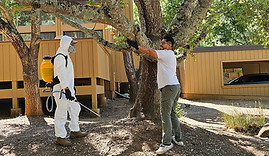
The diagnosis requires laboratory testing of leaf or bark samples. Our arborists collect samples and can arrange testing — the annual SOD Blitz project (coordinated with UC Berkeley) is one resource available each spring in San Mateo County. There are also laboratories available in Walnut Creek.
2025 SOD BLITZ REPORT - PENINSULA ZONE
⚠ EPIDEMIC STATUS CONFIRMED:
The San Francisco Peninsula Is Now a Critical SOD Hotspot
The 2025 SOD Blitz results for the Peninsula zone — which includes Portola Valley, Woodside, Atherton, Menlo Park, and Los Altos Hills — classify this region as HIGH risk for oak infection.
The statewide average infection rate in California bay laurels stood at 26.1%. In the Peninsula zone, local rates in bay laurels far exceed the 20% transmission threshold — the critical point at which spread to true oaks becomes imminent and highly probable.
This is not a future risk. This is an active epidemic. If you have Coast Live Oaks and Bay Laurels on your property in any of these communities, action is required now.
RATE
26.1%
STATE WIDE BAY LAUREL INFECTION RATE - 2025
2.5 mi
DIAMETER OF MEGA-OUTBREAK JUST NORTH OF WOODSIDE
2025 SOD BLITZ - PENINSULA ZONE CRITICAL FINDINGS
Four Findings Every Portola Valley &
Woodside Homeowner Must Know
There is no cure for Sudden Oak Death. But with the right protocol — applied at the right time — we can protect healthy oaks for up to 1 - 2 years per treatment cycle and significantly slow progression in early-stage infections.
Finding 01 — NA2 Strain Expansion
01
The NA2 Variant Has Exploded Across the Peninsula
First detected in Woodside and Burlingame in November 2024, the NA2 strain has expanded dramatically in 2025. This variant is estimated to be up to four times more infectious than the original NA1 strain and critically — it is heat-tolerant, thriving in the warmer, drier conditions that previously provided oaks a season of low risk.
With both strains now active simultaneously, there is no longer a "safe" season for Peninsula oaks near Bay Laurels.
Finding 02 — The Woodside Mega-Outbreak
02
A 2.5-Mile Outbreak Sits Directly North of Woodside
The 2025 Blitz identified a massive NA2 outbreak of at least 2.5 miles in diameter immediately north of Woodside — directly adjacent to the Portola Valley jurisdiction. Researchers suspect this represents the merger of four separate NA2 outbreaks that have grown together rapidly, creating a massive pathogen pressure zone across the entire forested mountainous region of the Peninsula. Properties bordering open space, creeks, or wooded hillsides face the highest direct exposure.
Finding 03 — 20% Transmission Threshold Exceeded
03
Bay Laurel Infection Rates Exceed the Critical 20% Threshold
Research by Dr. Garbelotto's laboratory has established that when bay laurel infection rates exceed 20% in a given zone, transmission to true oaks (Coast Live Oak, California Black Oak) becomes imminent and statistically probable. Peninsula zone bay laurel infection rates currently exceed this threshold. This means every unprotected Coast Live Oak on a property with Bay Laurels in Portola Valley, Woodside, or surrounding areas is in active danger of infection this season.
Finding 04 — Garbelotto Lab Urgent Guidance
04
UC Berkeley Issues Highest-Level Intervention Guidelines
Given the NA2 strain's virulence and the active epidemic conditions on the Peninsula in 2025, Dr. Garbelotto's laboratory is urging proactive phosphite treatment of all high-value oaks and the drastic removal of California Bay Laurels within 15–30 feet of oaks (up to 60 feet for monumental or heritage oaks). Critically, all mitigation work must follow strict tool sterilization protocols — the NA2 strain can be spread to uninfested areas via contaminated equipment. Only licensed, trained arborists should conduct this work.
OUR TREATMENT APPROACH
How Skyline Treats & Prevents
Sudden Oak Death
There is no cure for Sudden Oak Death. But with the right protocol — applied at the right time — we can protect healthy oaks for up to 1 - 2 years per treatment cycle and significantly slow progression in early-stage infections.
Property Assessment & Diagnosis
01
Every SOD engagement starts with a full property walk with an ISA-certified arborist. We evaluate each oak, map Bay Laurels and other host plants, assess infection risk based on proximity and environmental conditions, and identify any trees with active symptoms.
-
Visual inspection of all oaks, tanoaks, and Bay Laurels
-
Risk mapping — identifying which trees are within 150ft of known hosts
-
Sample collection for lab confirmation if symptoms are present
-
Written assessment report with prioritized recommendations
Bay Laurel & Carrier Plant Management
03
Because oaks only get infected from spores produced on host plants — not from other oaks — removing or managing Bay Laurels near your valuable oaks is the single most impactful prevention step. We identify and treat or remove foliar hosts strategically, without eliminating the diversity that makes your landscape valuable.
-
Strategic Bay Laurel removal within 30–50ft of high-value oaks
-
Pruning to reduce Bay Laurel canopy contact with oak canopy
-
Removal of infected leaf litter and organic debris
-
All tools sterilized between each tree to prevent cross-contamination
Oak Tree Treatment
02
Phosphonate fungicide is the only treatment registered by the California Department of Pesticide Regulation for Sudden Oak Death prevention. It works not by directly killing the pathogen, but by stimulating the tree's own immune response — triggering defensive chemicals and thickening protective cell layers.
-
Applied by phosphonate injection directly into the tree stem, or by trunk spray combined with Pentra-bark surfactant for bark absorption
-
Two applications in the first year, then annually each fall
-
Effective for oaks within 150ft of infected plants or Bay Laurels
-
Only effective when bleeding cankers cover less than 5% of trunk
-
Protection lasts up to 2 years per treatment cycle (UC research, Garbelotto 2009)
Ongoing Monitoring Program
04
SOD management is not a one-time treatment — it's a long-term program. We offer annual monitoring visits to reassess your property, check treatment efficacy, update your risk profile as disease pressure in the area changes, and apply booster treatments on schedule.
-
Annual fall re-assessment timed to peak treatment window
-
Booster phosphonate applications every 1–2 years
-
Updated risk assessment as new infections are confirmed nearby
-
Written treatment records for property disclosure.

10.8%
RATE
SAN MATEO TREES
INFECTED
WHAT SCIENCE SAYS
The 2024 Discovery That Changes Everything
For decades, Sudden Oak Death spread primarily during cool, wet winters — and slowed during droughts. Land managers and arborists planned their treatment windows around that pattern.
In November 2024, researchers at UC Berkeley led by forest pathologist Matteo Garbelotto discovered a new, aggressive lineage of Phytophthora ramorum — designated NA2 — in Woodside and Burlingame. Unlike the original strain, NA2 thrives in warmer, drier conditions.
"Experts worry that with the warming climate, the two forms can work in tandem, and even more trees could die across the state." — The Almanac, January 2025
The 2024 SOD Blitz — an annual citizen science survey covering 300,000 acres across 18 counties — found a 5.7% statewide infection rate, up 3% from 2023. In the sampling zone covering most of San Mateo County and parts of Santa Clara County, the rate was 10.8%. Your oaks are at greater risk today than they were two years ago.
DISEASE PROGRESSION
Why Acting Now Matters:
The SOD Timeline
Understanding where your tree is in this timeline determines what treatment options are available — and whether your oak can be saved.
Stage 0 — Prevention Window (Best Outcome)
Bay Laurels present, no symptoms on your oak
Your oak is at risk but not yet infected. This is the ideal time for preventative Agri-Fos phosphonate treatment, especially if infected plants are within 150–1,000 feet of your property. Two treatments in year one, then annual boosters. Full protection achievable.
Stage 1 — Early Infection (Treatment Still Effective)
Small trunk cankers, Bay Laurel leaf spots visible
Phytophthora ramorum is active on the property and possibly infecting your oak. Cankers are small (under 5% of trunk). Phosphonate treatment can still slow or suppress progression. Immediate Bay Laurel management is critical. Lab testing recommended to confirm SOD vs. other pathogens.
Stage 2 — Active Disease (Suppression Possible)
Bleeding cankers, twig dieback, bark beetles present
The disease is well-established. Treatment focus shifts to slowing progression, protecting remaining healthy tissue, and managing carriers to protect neighboring trees. Bark beetles are a secondary concern — they signal the tree is under significant stress. Structural assessment needed.
Stage 3 — Terminal (Removal Required)
Canopy browning, cankers over 5% of trunk, structural failure risk
Treatment cannot reverse the disease at this stage. The priority is safe, permitted removal before the tree becomes a hazard — and protecting the healthy oaks remaining on your property from further infection. A full property SOD management plan is prepared as part of removal.
How infection actually happens
During rain, spores drip or blow from Bay Laurel leaves onto neighboring oak trunks. The pathogen enters through bark openings, kills bark tissue, and clogs water and nutrient transport.
Source: Garden Club of Palo Alto / UC IPM, 2025
Why trees die "suddenly"
The brown canopy appears over 2–4 weeks — but the infection began 2–6 years earlier. Bark beetles attack trees already weakened by P. ramorum, accelerating decline.
Source: UC IPM Pest Notes
The Agri-Fos treatment window
Phosphonate treatment is only effective when: (1) the tree shows no symptoms OR early-stage infection only, (2) bleeding cankers cover less than 5% of trunk circumference, and (3) foliage has not yet started to brown.
Source: California Oak Mortality Task Force
Species that are NOT susceptible
White oak group species — Valley Oak (Quercus lobata), Garry Oak, and Blue Oak — are not susceptible to P. ramorum. Coast Live Oak and Tanoak are the primary Bay Area victims. If you're uncertain about your species, our arborists will identify every tree on your property.
Source: UC IPM
COMMON QUESTIONS
What Bay Area Homeowners Ask
About Sudden Oak Death
Is there a cure for Sudden Oak Death?
No — there is currently no cure for SOD. Agri-Fos phosphonate treatment is registered as a preventative, not a cure. It protects healthy trees and can slow early-stage infection, but cannot reverse established disease. This is why early action is so critical.
My oak looks completely healthy. Should I still treat it?
Yes — if you have Bay Laurels within 150 feet of your oaks, or if known SOD infections exist within 1,000 feet of your property, preventative treatment is strongly recommended. The best time to treat is before symptoms appear. Once you see symptoms, treatment options are more limited.
Do I need to remove all my Bay Laurels?
Not necessarily all of them — but strategic management of Bay Laurels near high-value oaks is the most important step in SOD prevention. We assess each situation individually and recommend targeted removal or pruning that balances protection with landscape preservation.
How often does my oak need phosphonate treatment?
The California Oak Mortality Task Force recommends two applications in the first year, then annually every fall in subsequent years for trees within 150 feet of infected plants. Research by UC Berkeley's Garbelotto Lab shows phosphonate protection lasts up to two years per treatment cycle.
Is my Valley Oak at risk?
Valley Oaks (Quercus lobata) are in the white oak group and are not susceptible to Phytophthora ramorum. Coast Live Oaks (Quercus agrifolia) and Tanoaks are the primary victims in the Bay Area. Our arborists will identify every species on your property during the free assessment.
Can the disease spread through my soil or tools?
Yes — Phytophthora ramorum can spread through infested soil and plant materials. State and federal regulations govern the movement of known host species. This is why we sterilize all tools between trees and follow strict sanitation protocols during any work on or near infected plants.
WHERE WE RESPOND
Highest-Risk Areas We Serve
San Mateo and Santa Clara Counties have the highest SOD infection rates in the Bay Area. We serve all communities where Coast Live Oaks and Tanoaks are at risk — including the highest-concentration zones where the NA2 strain was first detected.
WHAT OUR CLIENTS SAY
Oak Protection Reviews From Bay Area Homeowners
4.9
★★★★★
Based on 59+
Google Reviews
Angela McLeod
Portola Valley, Ca.
Exceptional customer service. Unmatched professional tree service. I truly cannot overstate how impressed we were with Joel Valencia and the team at Skyline Tree Experts. Our neighbors highly recommended their services to us and I can see why. Our entire neighborhood trusts them for tree care with a conservationist mindset.
★★★★★
Jennifer Smart
Woodside, Ca.
I highly recommend Joel and the team at Skyline Tree Experts for their responsiveness, their knowledge of the local Woodside landscape, and, most of all, for their knowledge of tree species and their ability to apply the right tree management tactic to the specific tree and situation.
★★★★★
Ken Kormanak
Portola Valley, Ca.
I've been a frequent user of this company for all my tree removal and trimming needs. They are professional, insured, courteous, and reasonably priced. They can do it all safely and clean up neatly after they're done. I would highly recommend them for your Tree Service needs.
★★★★★

Request Your Free Quote
SCHEDULE YOUR ASSESSMENT
Don't Wait Until
Symptoms Appear
The window for effective treatment is before visible symptoms — or within the first stages of infection. If you have Bay Laurels near your oaks, or if you've seen any warning signs, schedule a free assessment today. An ISA-certified arborist will contact you within one hour.
🔒 Secure · We never share your information · Reply within 1 hour